The principle of catalytic oxidation purification is as follows: under the action of an active catalyst (a precious metal catalyst) and at a specific temperature, combustible components in CO₂ gas—such as hydrocarbons, CH₃OH, H₂, and CO—react with oxygen to form CO₂ and H₂O. The purification level reaches the ppb range, ensuring that product specifications fully comply with the standards of the International Society of Beverage Technology (ISBT), the Chinese National Food Safety Standard “Food Additives—Carbon Dioxide” (GB 1886.228-2016), as well as the standards of “Coca-Cola” and “Pepsi-Cola.”
When producing liquid CO₂ finished products that meet industrial requirements, simply deactivate the hydrocarbon removal system. The catalytic oxidation process is an environmentally friendly process that generates no wastewater or waste liquid discharge during production.
Bypasses are configured at the inlet and outlet of the hydrocarbon removal process; when there is no need to remove hydrocarbons C₂ and above from the feed gas, the catalytic hydrocarbon removal process can be bypassed.
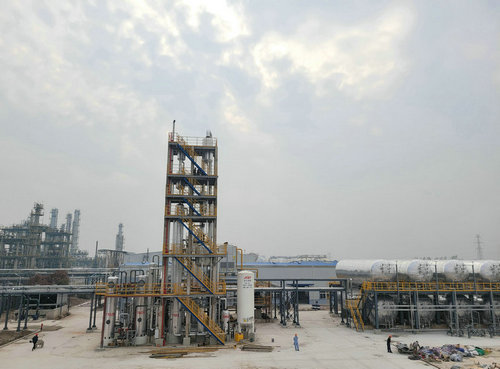
An integrated catalytic dehydrocarbonization purification tower is employed, combining a reactor, heat exchanger, and start-up electric heater into a single unit. This design fully leverages the advantages of proprietary spiral plate high-efficiency heat exchange. The dehydrocarbonization purification tower incorporates a high-efficiency heat exchanger, achieving self-thermal balance during operation without requiring external energy. This eliminates the need for special equipment materials required by high-temperature-difference heat exchange and avoids the need for external heat exchangers, thereby reducing capital investment and footprint. Installation of this dehydro-purification tower is straightforward, similar to that of standard pressure vessels. There is no need to assemble internal or external components during installation, and the tower contains no internal sealing packing. Catalyst loading and unloading is performed directly through manholes and discharge ports, requiring no welding—only the installation of inlet and outlet gas piping.
The startup electric heater can be remotely controlled via the DCS, facilitating operation. An automatic control system for the cold quench line is configured and interlocked with the tower temperature to ensure effective control of catalyst bed temperature in the event of overheating.
A bypass is installed in the catalytic dehydrogenation unit. When the unit is producing only industrial-grade liquid carbon dioxide, the feed CO₂ gas can enter the downstream system via the bypass, and the dehydrogenation unit is shut down.