


Address:South of 18th Floor, New Oriental International Technology Center, 567 Jiangling Road, Binjiang District, Hangzhou City
New product development
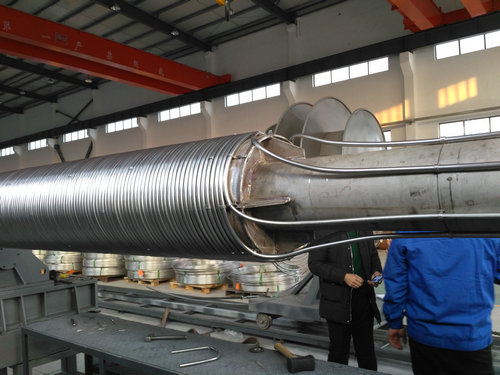
An Introduction to Our Company’s (Patented, Proprietary) Wound Tube Heat Exchanger
2024-09-27
Heat exchangers are indispensable pieces of equipment in industrial facilities. For many years, developed countries around the world have invested significant human and material resources in researching and developing heat exchangers that are highly efficient and compact in design. Currently, our company has developed coil-type heat exchangers in a variety of structural configurations. Due to their compact design, small footprint, and high heat transfer efficiency, as well as their ability to withstand high pressure, handle multi-stream heat exchange, and provide excellent thermal compensation, these heat exchangers have become the preferred critical process equipment in industries such as new energy, smelting, and petrochemicals—particularly in large-scale chemical and new energy facilities.

A New Process for Recovering Energy-Efficient Alcohol Fermentation Off-Gas to Produce High-Purity, Food-Grade CO₂
2024-09-27
During the fermentation process for producing ethanol from raw materials such as cassava and corn, large amounts of carbon dioxide are generated. Theoretically, the fermentation of starchy or sugary raw materials to produce 1 ton of ethanol releases 0.956 tons of carbon dioxide gas. For large and medium-sized ethanol producers, the volume of CO₂ released is clearly substantial. Recovering and processing this CO₂ into high-purity liquid CO₂ enables the production of downstream products such as solid dry ice and chemical feedstocks. CO₂ is a critical raw material in various industrial sectors. Recovering CO₂ not only reduces environmental pollution and generates economic and social benefits but also mitigates atmospheric pollution and the greenhouse effect.
A New Technology for Producing Green Methanol by Coupling Biomass Gasification with Water Electrolysis
2024-09-10
An important synthetic pathway for the industrial production of green methanol involves a process in which hydrogen is produced via water electrolysis using electricity generated by a hybrid wind-solar power system, and then combined with CO₂ to synthesize low-energy-consumption green methanol. This process combines wind and solar energy—two renewable energy sources—and converts them into chemical energy stored in methanol through a series of steps. The hybrid wind-solar system produces no greenhouse gas emissions, significantly reducing the carbon footprint of methanol production. By directly harnessing wind and photovoltaic solar energy from nature to replace traditional fossil fuels, this approach helps alleviate the pressure of global warming. However, since wind and solar power are highly susceptible to weather conditions and cannot provide a continuous, stable energy supply 24 hours a day, and given the high costs of electricity and energy storage, the biomass gasification coupled with green electricity for methanol production can be adopted to address challenges such as the difficulties in hydrogen storage and transportation, as well as the chemical industry’s requirement for stable and continuous production.
New Technology for Producing Green Methanol via Dual-Reactor Biomass Gasification (Zero Carbon Emissions)
2024-09-10
There are two main industrial production routes for green methanol: First, the green methanol production process based on biomass gasification. This process converts biomass resources into clean energy methanol, aiming to reduce dependence on fossil fuels and promote the carbon cycle. Second, the production process that uses electricity generated by a hybrid wind-solar power system to electrolyze water and produce hydrogen, which is then synthesized with CO₂ to produce low-energy-consumption green methanol. This process combines wind and solar energy—two renewable sources—and converts them into chemical energy stored in methanol through a series of steps. However, current implementation requires the construction of energy storage and hydrogen storage systems. Since methanol synthesis operates as a continuous production line, but wind and solar power are highly susceptible to weather fluctuations and thus unstable—meaning they cannot provide a stable, 24-hour energy supply—this places high demands on energy storage systems and the flexibility of production operations.
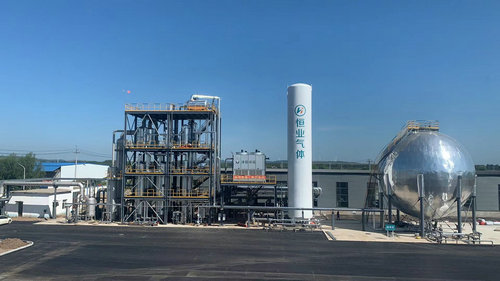
A New Process for Producing High-Purity Food-Grade CO₂ from Alcohol Vapor
2023-10-10
Edible alcohol is primarily produced using starchy raw materials such as tubers, grains, and corn. Under the action of microorganisms, the starch is hydrolyzed into glucose, which is then further fermented to produce alcohol. Additionally, alcohol is produced through the fermentation of molasses and the fermentation of waste liquor from sulfite pulp. The vent gas generated during the alcohol fermentation process typically contains a carbon dioxide concentration of over 95% in the raw gas exiting the fermenter, with other impurities including alcohols, aldehydes, esters, and sulfides.
New Technology for the Recovery and Recycling of Associated Gas CO₂ at Oilfield Wellheads
2023-07-14
Currently, most oilfields in China are utilizing CCUS projects to conduct large-scale secondary and tertiary oil recovery (e.g., Shengli Oilfield, Xinjiang Oilfield, etc.). As oil and gas fields enter the mid-to-late stages of development, many fields are actively upgrading their technologies to improve oil and gas recovery rates. Carbon dioxide (CO₂) flooding is a widely adopted reservoir recovery technique. When CO₂ dissolves in water within the formation, it increases the water’s viscosity by 20% to 30%. When dissolved in oil, carbon dioxide causes the crude oil to expand in volume, reduces its viscosity by 30%–80%, and lowers the oil-water interfacial tension. This facilitates increased oil production rates, improves oil displacement efficiency, and aids in the recovery of residual oil. CO₂ EOR typically increases crude oil recovery rates by 7%–15% and extends the production life of oil wells by 15–20 years. In large-scale CO₂ flooding operations, the associated gas produced during the process contains a significant proportion of CO₂. By recovering, reinjecting, and utilizing this CO₂ directly at the wellsite, a closed-loop CO₂ recycling system can be achieved. This not only significantly reduces greenhouse gas emissions into the atmosphere but also substantially lowers the costs associated with purchasing and transporting CO₂ for flooding, resulting in savings of 30%–60% on CO₂ raw material and transportation expenses.
Contact Us
Address:South of 18th Floor, New Oriental International Technology Center, 567 Jiangling Road, Binjiang District, Hangzhou City

Phone:+86-571-87177512 87177550 87177513

Email:hangzhoukuaikai@vip.163.com

Fax:0571-87177570
Quick Navigation

Browse the mobile website