


Address:South of 18th Floor, New Oriental International Technology Center, 567 Jiangling Road, Binjiang District, Hangzhou City
New product development
There are two main industrial production routes for green methanol: First, the green methanol production process based on biomass gasification. This process converts biomass resources into clean energy methanol, aiming to reduce dependence on fossil fuels and promote the carbon cycle. Second, the production process that uses electricity generated by a hybrid wind-solar power system to electrolyze water and produce hydrogen, which is then synthesized with CO₂ to produce low-energy-consumption green methanol. This process combines wind and solar energy—two renewable sources—and converts them into chemical energy stored in methanol through a series of steps. However, current implementation requires the construction of energy storage and hydrogen storage systems. Since methanol synthesis operates as a continuous production line, but wind and solar power are highly susceptible to weather fluctuations and thus unstable—meaning they cannot provide a stable, 24-hour energy supply—this places high demands on energy storage systems and the flexibility of production operations.
During its early stages, Hangzhou Kuai Kai possessed advanced process technologies in the field of methanol synthesis, as well as proprietary isothermal, shell-and-tube, and air-cooled coil-type methanol synthesis reactors. These various reactor types are suitable for synthesis reactions under different feed gas conditions. Since 1992, the R&D team has specialized in methanol synthesis process packages and reactors, having constructed over 100 methanol synthesis projects and made significant contributions to China’s co-production of methanol and ethylene, as well as low-pressure and high-pressure methanol production. With the development of new energy sources in China, biomass gasification for green methanol production—using straw and woody biomass as feedstock—involves pre-treating the biomass and utilizing high-temperature fluidized-bed gasification processes and equipment to produce bio-based synthesis gas containing H₂, CO, and a small amount of CO₂. This replaces coal-based synthesis gas and enables the production of green H₂ and green methanol.
Technical Features:
In the green methanol synthesis process using biomass gasification gas as feedstock, the main components are CO, H₂, and a small amount of CO₂. Currently, most processes involve first recovering CO₂ and then hydrogenating CO to synthesize methanol. This process is complex and involves high capital costs. Therefore, Kuai Kai has invested in the research and development of a dual-reactor process route for synthesizing green methanol. In this process, the gas produced by biomass gasification first passes through a CO-H₂ reactor. After methanol is separated, the remaining un反応 gas then passes through a CO₂-H₂ reactor to synthesize green methanol. This method eliminates the need to separate CO₂, significantly simplifying the production process and improving the yield of green methanol.
Process Flow Diagram:
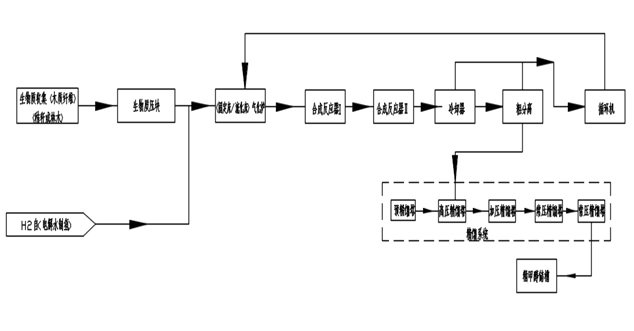
The green methanol produced through our company’s patented technologies, proprietary know-how, and collaborative R&D efforts holds exceptionally broad market prospects. Our company possesses a proprietary process package for green methanol synthesis, including reactors and specialized catalysts for CO + H₂ and CO₂ + H₂ reactions. By facilitating the recovery and utilization of CO₂, we are advancing toward a green, low-carbon, circular, and sustainable development model, thereby promoting the growth of the new energy industry chain.
Contact Us
Address:South of 18th Floor, New Oriental International Technology Center, 567 Jiangling Road, Binjiang District, Hangzhou City

Phone:+86-571-87177512 87177550 87177513

Email:hangzhoukuaikai@vip.163.com

Fax:0571-87177570
Quick Navigation

Browse the mobile website