Since the 1990s, with the rapid development of high-tech industries in China, high-tech fields such as integrated circuits (ICs), light-emitting diodes (LEDs), solar cells, and optical fibers have experienced rapid growth. Against this backdrop, ultra-high-purity (electronics-grade) carbon dioxide offers vast application potential. It is primarily used in high-tech fields such as lasers, the electronics industry, reactor gas coolants, critical extraction in medicine, and scientific research. In the production processes of high-tech products, ultra-high-purity (electronics-grade) carbon dioxide gas plays a crucial role in determining the final product quality, and its quality control standards are extremely stringent. Currently, products with a purity of ≥99.995% are referred to as high-purity CO₂ products in the domestic market. However, these products contain relatively high levels of impurities such as moisture and oxygen, resulting in a significant gap compared to high-purity CO₂ products from abroad. Consequently, the application of domestic high-purity carbon dioxide in high-end technology fields is significantly limited.
Hangzhou Kuai Kai Ultra-High-Purity (Electronic-Grade) Carbon Dioxide Technology
To break the reliance on imported high-purity CO₂ products in China, Hangzhou Kuai Kai High-Efficiency Energy-Saving New Technology Co., Ltd. has successfully developed ultra-high-purity (electronic-grade) carbon dioxide production technology and obtained a national patent. Currently, an annual production base with a capacity of 1,200 tons has been established at Fujian Zhisheng Chemical Co., Ltd. The ultra-high-purity (electronics-grade) CO₂ produced there has a purity of ≥99.999% (CO₂ purity ≥99.999%, volatile hydrocarbon content ≤0.5 ppm, moisture content ≤1.0 ppm), The product quality meets the quality standards for high-purity carbon dioxide set by Showa Denko of Japan and is scheduled to be launched in May 2016. Our company can produce a series of CO₂ products meeting various quality standards according to the specific requirements of different customers.
Methods for Producing Ultra-High-Purity (Electron-Grade) Carbon Dioxide and Outlook on Core Technologies
Xu Meinan, Zhang Liqun, Shen Jianchong
(Hangzhou Kuai Kai High-Efficiency Energy-Saving New Technology Co., Ltd., Hangzhou, 310009)
Abstract: This paper examines the production process and technical characteristics of ultra-high-purity (electronics-grade) carbon dioxide and provides an outlook on its future development.
Keywords: ultra-high-purity (electronics-grade), carbon dioxide, technology, development;
1 Introduction
Since the 1990s, with the rapid development of high-tech industries in China, high-tech fields such as integrated circuits (ICs), light-emitting diodes (LEDs), solar cells, and optical fibers have experienced rapid growth. In the production processes of products in these high-tech fields—from chip growth to final device packaging—almost every step and every stage relies on high-purity (electronics-grade) gases to ensure the manufacture of reliable devices. Among these, high-purity (electronics-grade) carbon dioxide is primarily used in laser cutting machines as a laser gas, in the electronics industry, as a reactor gas coolant, for critical extraction in medicine, and in semiconductor manufacturing for oxidation, diffusion, chemical vapor deposition, and supercritical cleaning gases.
Similar to the optoelectronics and microelectronics industries, research and production of high-purity (electronics-grade) carbon dioxide gas in China started relatively late, and funding has been relatively insufficient. Since the reform and opening-up, the Chinese government has designated the IC industry as a key pillar industry for national development, and the electronics, optoelectronics, and optical fiber manufacturing sectors have experienced rapid growth. As international competition in the IC industry intensifies, China’s reliance on imported electronic gases for IC production is facing severe market challenges. Consequently, Chinese IC manufacturers have long sought to establish domestic research and production capabilities for high-purity (electronics-grade) carbon dioxide gas. This would address the “source” issue in IC production, fundamentally alleviate concerns within the IC manufacturing sector, and break through the “bottleneck” hindering the development of megabit-scale and VLSI-scale integrated circuits.
2 High-Purity (Electronics-Grade) Carbon Dioxide Technology and Current Status
Internationally, manufacturers of high-purity carbon dioxide place great emphasis on controlling quality indicators for high-purity (electronic-grade) carbon dioxide. In particular, they impose strict limits on impurities harmful to electronic industrial products and medical research—such as various hydrocarbons, ammonia, sulfides, nitrogen oxides, cyanides, alcohols, aldehydes, esters, and ethers—and implement quantitative control measures. Currently, Showa Denko K.K. of Japan is one of the international manufacturers of high-purity (electronics-grade) carbon dioxide, having established and implemented its own corporate quality standards for the product. As China’s market economy integrates with the international market, it has become imperative for the quality of high-purity (electronics-grade) carbon dioxide—which directly impacts product quality in the electronics industry and the outcomes of medical research—to align with international standards. In September 2009, China promulgated the GB/T 23938-2009 quality standard for high-purity carbon dioxide; however, the quality requirements established by this standard are relatively low.
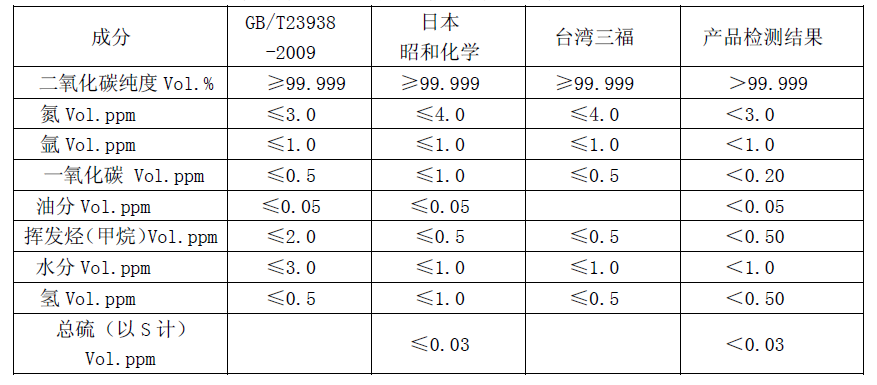
With the development of lasers, supercritical extraction, reactor gas cooling, and the scientific sector—particularly the booming electronics industry—demand for high-purity (electronics-grade) carbon dioxide in light-emitting diodes and flat-panel displays has surged in recent years. However, there are currently almost no continuous, stable production lines for high-purity (electronics-grade) carbon dioxide in China’s market. Against this backdrop, Hangzhou Kuai Kai Company leveraged over a decade of research in the food-grade carbon dioxide sector to develop advanced production technologies and secure numerous patents. Through further in-depth research and meticulous design optimization, the company constructed a 1kt/a ultra-high-purity (electronics-grade) carbon dioxide production line. Following trial operations, the facility successfully met all performance metrics on the first attempt, exceeding the standards set by Japan’s Showa and Taiwan’s Sanfu. Its purity exceeds 99.999%.
Table 1.1 Comparison of Hangzhou Kuai Kai Co., Ltd.’s Ultra-High-Purity CO₂ Product Quality with Various Standards
3 Technical Features
Since high-purity (electronics-grade) carbon dioxide requires not only a purity of 99.999% or higher but also impurity concentrations as low as the PPb (parts per billion) level, extremely high standards are required in terms of process design, process control, and analytical accuracy. For over a decade, Hangzhou Kuai Kai has leveraged its technical expertise in food-grade liquid carbon dioxide. By selecting high-quality food-grade liquid carbon dioxide as raw material and employing a new process that combines physical adsorption, chemical treatment, and related patented technologies, the company has achieved ultra-high-purity (electron-grade) carbon dioxide products with a consistently stable purity of 99.999% or higher. The product quality meets the requirements of Showa Denko’s high-purity CO₂ quality standards as well as national standards for high-purity CO₂.
Hangzhou Kuai Kai’s high-purity CO₂ manufacturing process is as follows:
Raw Material → Pretreatment → Purification (New Process) → Deep Purification → Product Storage Tank
(99.9% CO₂) (Chemical and Physical Adsorption)
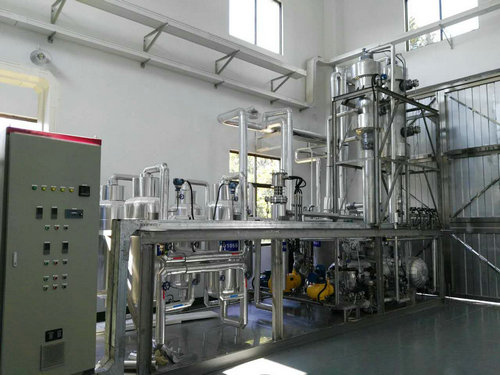
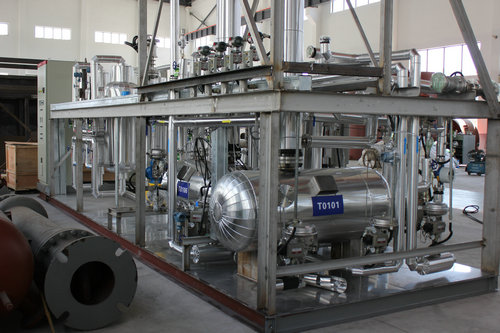
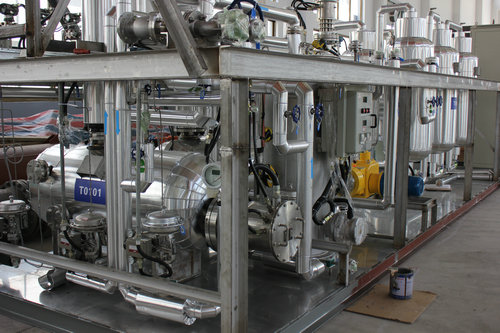
This process uses food-grade liquid carbon dioxide as the raw material, which typically has a purity of 99.9% or higher, contains few impurities, and has low levels of carbon monoxide and hydrogen. By utilizing the new purification process, relevant impurities in the product can be effectively removed; The production process features low raw material loss. The energy balance and recovery in the new purification process result in low power consumption. The process is relatively simple and reliable, with high product yield and low capital investment. Due to the stringent requirements for impurity levels, multi-stage distillation presents a key challenge in process control. After extensive testing, Hangzhou Kuai Kai selected imported high-efficiency packing material, effectively reducing the height of the purification column and achieving efficient separation of light and heavy components, thereby significantly reducing equipment investment and energy consumption. Most crucially, the entire unit is configured as a skid-mounted system. From raw material feed to product output, the entire unit features a compact, aesthetically pleasing, and user-friendly integrated layout, occupying a minimal footprint and requiring low capital investment.
4 Outlook on High-Purity Carbon Dioxide Manufacturing Technology in China
Overall, the development of high-purity (electronics-grade) carbon dioxide gas in China lags behind international standards. However, the importance of high-purity (electronics-grade) carbon dioxide in its application fields, as well as its role in constraining China’s cutting-edge technologies, has attracted significant attention from senior government authorities. Consequently, the state has begun providing financial support through multiple funding channels for the research and industrial production of domestically produced ultra-high-purity (electronics-grade) carbon dioxide gas.
Hangzhou Kuai Kai Company’s completed 1kt/a high-purity (electronics-grade) CO₂ project has successfully commenced production. The product has been tested by authoritative national institutions, and all indicators exceed the requirements of Japan’s Showa, Taiwan’s Sanfu, and national standards. This is a promising start that has played a significant role in balancing the prices of international electronic gases in China. As China’s electronics industry continues to develop, domestic high-purity (electronics-grade) carbon dioxide gas is poised for further breakthroughs, and its market share will inevitably continue to grow.
References
1 Niu Lihong, Yu Shilin. Current Status of High-Purity Gas Applications in China [J]. Cryogenics and Special Gases, 2010, 28(3): 7-9.
2 Sun Funan, Han Mei, Chen Xiaohui, et al. Current Status and Development Trends of Electronic Gases in China [J]. Cryogenics and Special Gases, 2004, 22(6).
3 Sun Funan, Yue Wenyuan. 2013 China Gas [J]. Cryogenics and Special Gases, 2013, 31(6): 1-5.
4 Xu Meinan, Shen Jianchong. Introduction to Domestic Food-Grade Carbon Dioxide Technology Meeting International Quality Standards [A][J]. Proceedings of the 18th Subcommittee on Carbon Dioxide Emission Reduction, Green Utilization, and Development at the 10th Annual Conference of the China Association for Science and Technology, 2008.
5 Liang Guolun, Yu Jingsong. Advances in Electronic Gas Technology Abroad [J]. Semiconductor Technology, 2001, 26(2): 25-28.
6 Cui Shian. Specialty Gas Market and Applications [J]. Cryogenics and Specialty Gases, 1999, 1: 13.