


Address:South of 18th Floor, New Oriental International Technology Center, 567 Jiangling Road, Binjiang District, Hangzhou City
News
Ningbo Wanhua Polyurethane Co., Ltd. was established on February 27, 2006, as a subsidiary of Yantai Wanhua Polyurethane Co., Ltd. To further solidify the company’s position in the global MDI industry and and strengthen its capabilities. Construction of the 200kt/a MDI project began in August 2003 in the Daxie Development Zone of Ningbo and was successfully completed and put into operation in 2006. In 2008, the second-phase project—comprising a 300kt/a MDI unit, a 400kt/a VCM unit, a 55,000 Nm³/h air separation unit, a 100,000 Nm³/h coal gasification unit, a 100kt/a synthetic ammonia unit, a 170kt/a nitric acid unit, a 250kt/a aniline unit, a 200kt/a methanol unit, a 150kt/a chlor-alkali unit, and two 100,000-ton HCl oxidation units. These facilities were completed and put into operation in October 2010.
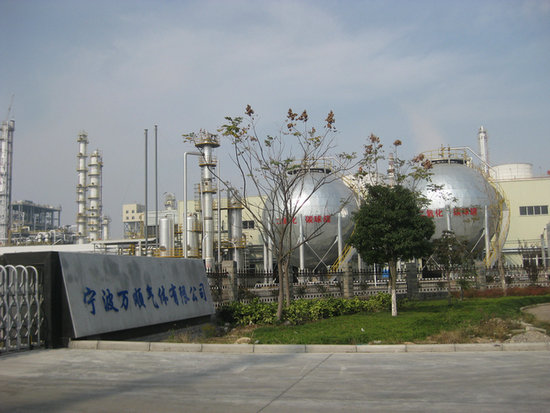
The production processes of the synthetic ammonia and methanol plants generate large volumes of CO₂-rich waste gas emissions. This not only has a severe impact on the human living environment and exacerbates the “greenhouse effect,” but also results in the waste of CO₂ resources. This also fails to meet the requirements of the scientific development concept, energy conservation, emission reduction, and the circular economy proposed by the state. Consequently, Ningbo Wanshun Gas Co., Ltd. was established to construct a new liquid carbon dioxide production unit featuring advanced technology and high-quality products. This unit utilizes industrial CO₂ waste gas emitted from the low-temperature methanol stripping decarbonization unit of Ningbo Wanhua Polyurethane Co., Ltd.’s synthetic ammonia system to produce liquid CO₂ products in line with market demand. To ensure thoroughness, Wanshun conducted nearly a year of research and comparison of the reliability of various domestic liquid carbon dioxide production technologies. Ultimately, they decided to adopt the new liquid carbon dioxide production technology and patented equipment developed by our company. We were tasked with determining the design plan based on the composition of Wanshun’s CO₂ feed gas, as well as carrying out the engineering design, commissioning, and debugging.
The plant employs the international standard food-grade liquid carbon dioxide production process and patented equipment developed by our company, which includes ambient-temperature precision desulfurization, catalytic oxidation dehydrocarbonization, and shallow-low-temperature rectification purification. Its technical features are as follows:
2. Moisture removal employs specialized molecular sieve adsorption with high dehydration precision, reducing moisture content to below 20 ppm. An online moisture analyzer is used for real-time monitoring to ensure timely regeneration of the molecular sieves and effective control of product moisture levels.
3. The removal of toxic and harmful substances, such as hydrocarbons, benzene, and various oxygen-containing organic compounds, is achieved using a purification tower developed with our company’s patented equipment. This system employs internationally recognized catalytic oxidation technology to ensure the complete combustion of toxic and harmful organic compounds at relatively low temperatures (around 420°C). A total hydrocarbon analyzer is integrated into the production control system to ensure the thorough removal of hydrocarbons, benzene, alcohols, aldehydes, and other oxygen-containing organic compounds.
4. The gas, after hydrocarbon removal, undergoes distillation under mild low-temperature conditions using a new composite purification tower based on our proprietary technology. This not only ensures high product purity but also significantly reduces the purity of carbon dioxide in the vent gas, effectively resolving the conflict between gas consumption and purity.
5. The entire process operates under medium-to-low pressure and at ambient or slightly sub-zero temperatures, resulting in low equipment manufacturing costs and full localization of the entire plant.
6. The plant features a compact layout with a small footprint and employs centralized control, ensuring convenient and stable operation.
7. The product quality is excellent, with all indicators meeting or exceeding China’s new national standards, as well as those of Coca-Cola, PepsiCo, and the International Beverage Technology Association.
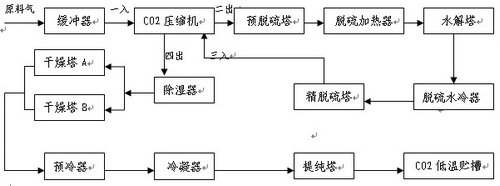
After being buffered in a buffer tank, the carbon dioxide feed gas enters the first and second stages of the compressor for compression, cooling, and condensate separation. It then passes through a filter to remove inorganic sulfur, is heated in a desulfurization heater, and proceeds to the hydrolysis tower for hydrolysis, converting COS to H₂S. The gas is subsequently cooled in a desulfurization water cooler and sent to the refined desulfurization tower to remove the generated H₂S, resulting in a total sulfur content of ≤0.1 ppm. After desulfurization, the gas undergoes third- and fourth-stage compression, cooling, and condensate separation. It then passes through a dehumidifier to reduce the saturated water content in the CO₂ gas, followed by entry into the drying tower (one in operation, one on standby). The molecular sieve adsorbent within the tower adsorbs and dries the saturated water in the gas, reducing the moisture content to ≤20 ppm. (When the moisture content approaches 20 ppm, the standby tower is activated, and the active tower is taken offline for regeneration. During regeneration, the vent gas from the purification tower is heated to approximately 180°C using steam introduced through the regeneration steam heater. Regeneration ends when the outlet temperature of the molecular sieve regeneration gas reaches ≥120°C. The gas is then cooled to ambient temperature using the purification tower vent gas and pressurized with dry gas before being placed on standby.) After the gas meets the moisture content requirements, it is sent to the pre-cooler to utilize the residual heat from the purifier tower vent gas, then enters the condenser for cooling, condensation, and liquefaction before entering the purifier tower. The gas in the heat exchange section at the bottom of the purifier tower is CO₂ that has been dried and dehydrated by molecular sieves, maintaining the bottom temperature at approximately -15°C. Liquid CO₂ entering the purification tower exchanges heat with the hot gas from the heat exchange section, partially vaporizing to evaporate low-boiling-point impurities. The CO₂ that has evaporated along with the impurity gas from the lower part of the tower is recondensed via the ammonia condenser at the tower top, reducing consumption and improving yield. The liquid CO₂ exiting the bottom of the purification tower enters a cryogenic storage tank. Non-condensable gases are vented from the tower top after undergoing throttling and cooling to recover some energy. They then pass through a pre-cooler to recover additional cooling capacity before being sent to the molecular sieve bed for regeneration and cooling, after which they are vented.
IV. Plant Operation Status:
Design of the unit began in January 2010. By July 2010, installation of the main equipment was completed, and preparatory work—including system purging, pressure testing, and thermal insulation—was finished. Due to delays in Wanhua’s ammonia synthesis unit, the carbon dioxide unit did not begin feedstock injection and start-up until November 8, 2010. Through the joint efforts and cooperation of technical personnel from Wanshun and our company’s technical service team, the unit achieved a successful first-time start-up and produced qualified products. Under conditions where the feed gas carbon dioxide purity was only 82% (the design specification is 86%), liquid carbon dioxide product was produced with a purity of over 99.8%. Following production commissioning from November 9 to 23, the plant operated normally at full capacity (9,500 Nm³/h). According to on-site production tests, when the carbon dioxide purity in the feed gas was only 75–82%, the product purity reached 99.8%, with a production rate of 300–330 t/d and an energy consumption of 216–230 kWh/tCO2. The production capacity, various process parameters, and quality indicators all exceeded design requirements. If the carbon dioxide purity in the feed gas can reach 86% or higher, the results will be even more impressive. Currently, product quality meets all national standards for liquid carbon dioxide.
In summary, the application of our company’s patented liquid carbon dioxide production technology at Wanshun Company has proven ideal, featuring low investment, high-quality and stable products, and low energy consumption. It represents the optimal choice for relevant enterprises seeking to recover and utilize surplus carbon dioxide, develop a circular economy, conserve energy and reduce emissions, lower production costs, and enhance market competitiveness. It also aligns with relevant national policies. We hope that our company’s unique patented technology will make an even greater contribution to China’s energy conservation and emission reduction efforts.
Contact Us
Address:South of 18th Floor, New Oriental International Technology Center, 567 Jiangling Road, Binjiang District, Hangzhou City

Phone:+86-571-87177512 87177550 87177513

Email:hangzhoukuaikai@vip.163.com

Fax:0571-87177570
Quick Navigation

Browse the mobile website